

 Products
 Bars
Bars
 Beads & Spheres
 Bolts & Nuts
 Crucibles
 Discs
Discs
 Fibers & Fabrics
 Films
Films
 Flake
Flake
 Foams
Foams
 Foil
Foil
 Granules
 Honeycombs
 Ink
Ink
 Laminate
 Lumps
Lumps
 Meshes
 Metallised Film
 Plate
Plate
 Powders
 Rod
Rod
 Sheets
 Single Crystals
 Sputtering Target
 Tubes
Tubes
 Washer
 Wires
Wires
 Converters & Calculators
 Write for Us



Tantalum Carbide: A High-Performance Material for Extreme Applications

Tantalum carbide (TaC) is a compound that combines the strength of tantalum with the hardness of carbon. Here's a look at why this material is so valued, what makes it unique, and where it's used.

1. What Is Tantalum Carbide?
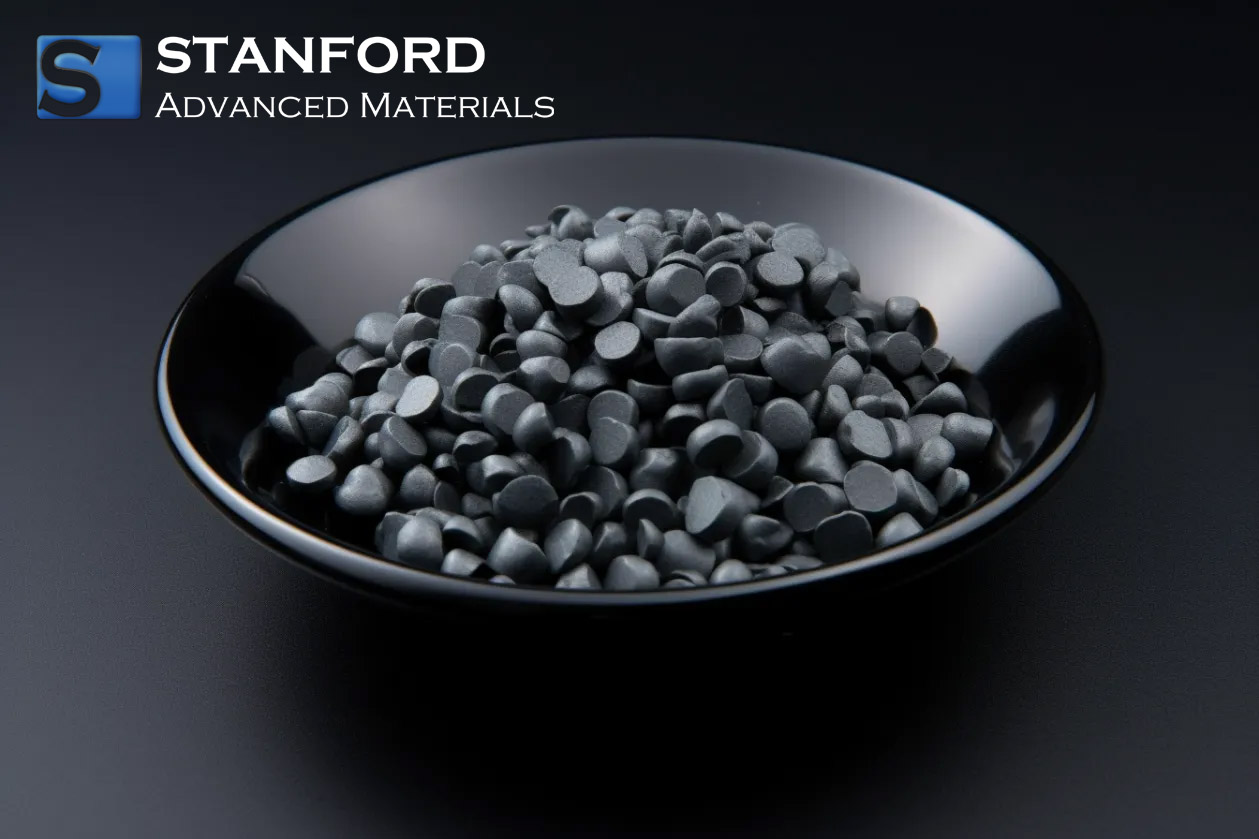
Tantalum carbide is a ceramic compound that consists of tantalum and carbon. It is one of the strongest substances that exist in nature, with a high melting point above 3,880°C (7,004°F). This makes it highly suitable for use in conditions where materials are forced beyond their limits. It is a subgroup of transition metal carbides, recognised and renowned for its high strength, high melting point, and durability against wear and corrosion.
Indeed, many materials are known for their resistance to higher temperatures and hardness. However, very few possess both properties as abundantly as tantalum carbide. This characteristic combination of properties renders tantalum carbide an ideal material for use in all industries that require exposure to extreme conditions without becoming damaged.

2. Important Characteristics of Tantalum Carbide
Exceptional Hardness & Wear-Resistance Properties
In fact, it is the second hardest substance that exists. It is only slightly less hard than diamonds. If its hardness is measured on the Mohs hardness test, then its value is 9, which is the second highest value, only surpassed by diamonds. Therefore, when it comes to the preparation of components that are to work in environments where resistance to wear is essential, tantalum carbide is the best.
Related reading: The 10 Strongest Materials Known To Man
Outstanding Thermal Stability
Such property makes TaC a very important compound in different industries where high temperatures can melt other materials easily. Its high melting point is approximately 3,880 degrees Celsius.
Corrosion & Chemical Resistance
One property that stands out for tantalum carbide is high resistance to corrosion and chemical damage. This property also includes high resistance to corrosion by both acids and bases. This property places it in high demand in environments that would corrode other metals quickly.
Electrical Conductivity
However, despite the fact that the main property of tantalum carbide is its hardness and resistance to heat, this material holds a certain degree of electric conductivity. Of course, this property is inferior to the electric conductivity of metals such as copper, but it is sufficient for use in specific applications involving electronics and semiconductors, where a sufficient degree of thermal and electric properties is required.
Brittleness
Although the hardness exhibited by tantalum carbide is very high, the compound can still be quite brittle. This may seem unusual for a compound whose hardest property exhibited. This brittleness can cause the compound to break or even fracture when subjected to strong impact. This can be addressed when the compound is combined with other elements, such as cobalt or tungsten.
3. Uses of Tantalum Carbide
The unique properties that tantalum carbide exhibits make it extremely useful in different applications.
Cutting Tools and Wear Resistant Coatings: Tantalum carbide is used in the production of cutting tools and wear-resistant films. It is an excellent component of tools that suffer from constant friction, such as drill bits and milling cutters. The other use of the product is in making films for prolonging the life and improving the performance of tools to maintain their sharpness and longevity. Its applications in metalworking are to provide tools with longevity and reduce downtime due to tool failures.
Chemical Processing: In chemical processing, where the requirement for resistance to corrosion is paramount, tantalum carbide is used in equipment such as heat transfer equipment, reactors, and valves. Corrosion and high-temperature resistance makes it more durable, reducing replacement and repair cycles. Due to its high resistance to corrosion and heat, TaC is preferred in oil refining and in petrochemical processes.
Semiconductors & Electronics: Even though tantalum carbide isn't nearly as widely used for semiconductor manufacturing as some other materials, its applications are increasing. It's being developed for electronics requiring a combination of resistance to higher temperatures and a degree of electrical conductivity.
Related reading: Why Tantalum Carbide Is Ideal for Cutting Tool Coatings
4. Tantalum Carbide Compared to Other Materials
Despite its high properties, however, tantalum carbide is not the only material that can be utilised when high-performance requirements are involved. It is normally evaluated alongside other material types with high hardness and temperature resistance.
A comparison of tantalum carbide with a couple of other material types is as follows:
|
Material |
Hardness |
Melting Point |
Corrosion Resistance |
Brittleness |
Typical Applications |
|
Tantalum Carbide (TaC) |
9 on Mohs scale |
3,880°C (7,004°F) |
Excellent, especially in acidic environments |
High (brittle) |
Cutting tools, chemical processing |
|
Tungsten Carbide (WC) |
9 on Mohs scale |
3,422°C (6,192°F) |
Good, but less corrosion-resistant than TaC |
Moderate (tougher than TaC) |
Mining, metalworking, drilling |
|
Titanium Carbide (TiC) |
9 on Mohs scale |
3,220°C (5,828°F) |
Good, but less than TaC |
Moderate (less brittle than TaC) |
Aerospace, cutting tools |
|
Boron Carbide (B4C) |
9.5 on Mohs scale |
2,350°C (4,282°F) |
Excellent, especially in abrasives |
High (brittle) |
Abrasives, nuclear shielding |
|
Chromium Carbide (Cr3C2) |
8.5 on Mohs scale |
2,480°C (4,496°F) |
Excellent, especially in oxidative conditions |
High (brittle) |
Wear-resistant coatings |
Key Comparisons:
• Hardness: Tantalum carbide and tungsten carbide possess high hardness. Here, TaC possesses a slight advantage in heat-resisting properties because of its relatively higher melting point. However, boron carbide possesses a higher hardness than all the above materials but is very brittle.
• Corrosion Resistant: Tantalum carbide is very corrosion-resistant, especially in an acidic environment, making it suitable for processing chemical products. Second, tungsten carbide may be hard and corrosion-resistant but does not work well in very corrosive conditions.
• Brittleness: Though the brittleness of tantalum carbide is very high, it is not much different from the brittleness of carbides like boron carbide. The brittleness of tungsten carbide and titanium carbide is relatively lower, and thus these are applicable for the required impact resistance.
• Applications: Tantalum carbide is applied where high thermal stability, hardness, or corrosion resistance is required. In high-impact or abrasive environments, such as mining or metal drilling operations, it is often desirable to have the toughness of tungsten carbide rather than the hardness of tantalum carbide.
Conclusion
Tantalum Carbide is renowned for its hardness, stability, and corrosion-resistant properties. Though it is brittle, it is an essential component in cutting tools and chemical industries, among many others. The advancing technologies of composite materials and manufacturing processes are expected to ensure an increasing list of tantalum carbide applications in coming times, keeping it at the forefront of innovations. For more hard materials, please check Stanford Advanced Materials (SAM).
 Dr. Samuel R. Matthews


