

 Products
 Bars
Bars
 Beads & Spheres
 Bolts & Nuts
 Crucibles
 Discs
Discs
 Fibers & Fabrics
 Films
Films
 Flake
Flake
 Foams
Foams
 Foil
Foil
 Granules
 Honeycombs
 Ink
Ink
 Laminate
 Lumps
Lumps
 Meshes
 Metallised Film
 Plate
Plate
 Powders
 Rod
Rod
 Sheets
 Single Crystals
 Sputtering Target
 Tubes
Tubes
 Washer
 Wires
Wires
 Converters & Calculators
 Write for Us



5 Key Fluoride Crystals in Optics and Lasers

Fluoride crystals possess several key features that make them important for use in optics and lasers: high transparency within the IR range, low dispersion, and properties such as radiation hardness or scintillation. These favourable properties provide many applications in laser generation, optical communication, spectroscopy, and thermal imaging. We will look at five crucial fluoride crystals that have become indispensable in these fields and each offers advantages depending on the particular application.

1. Calcium Fluoride (CaF₂)
Out of all the fluoride crystals used in optics and laser systems, calcium fluoride is probably the most versatile and widely used. Its wide transparency range, spanning from UV to IR, recommends calcium fluoride for a variety of optical components.
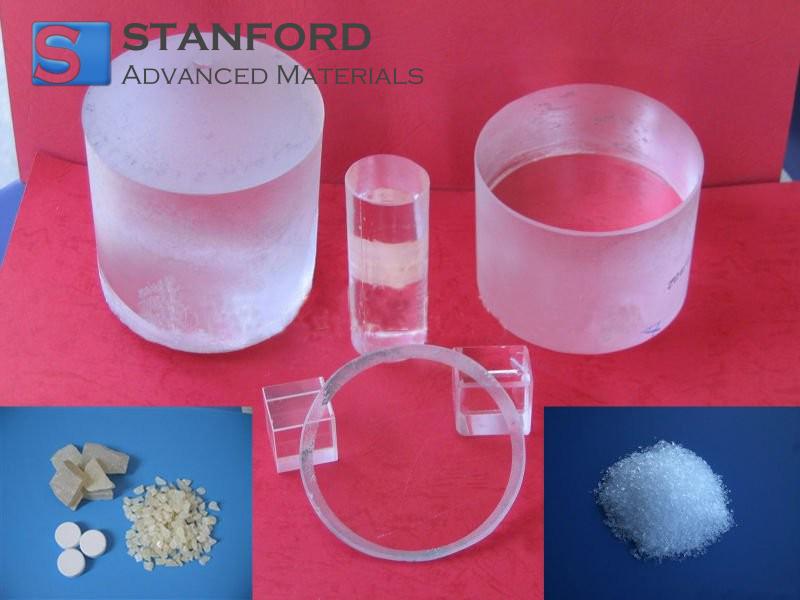
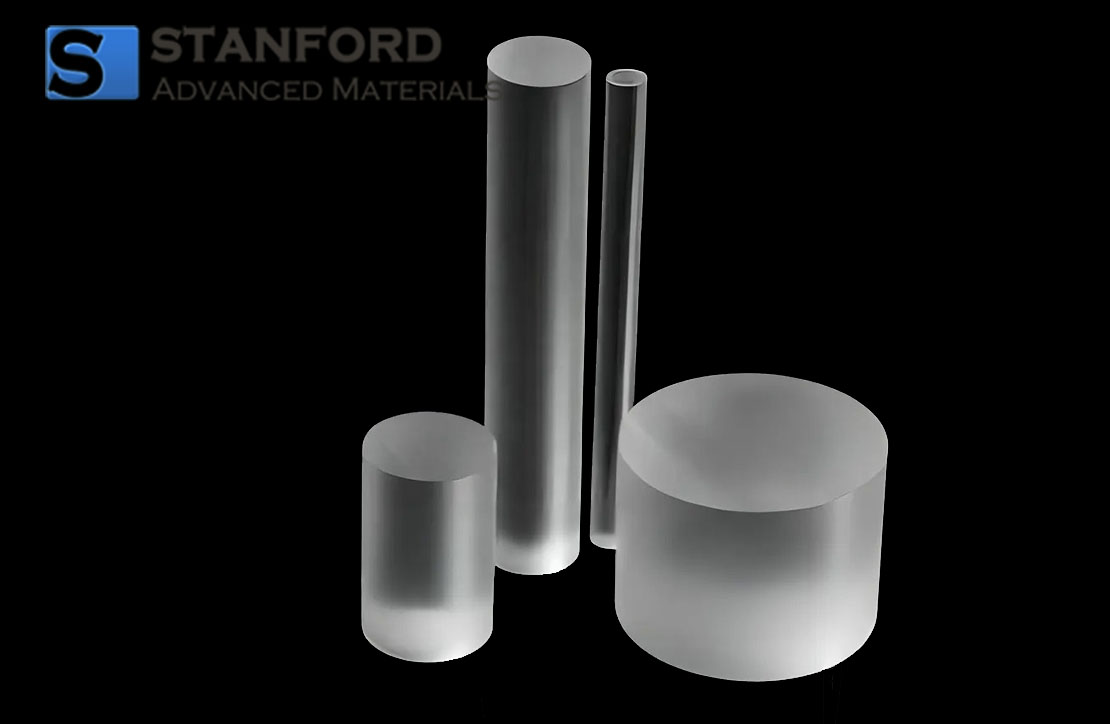
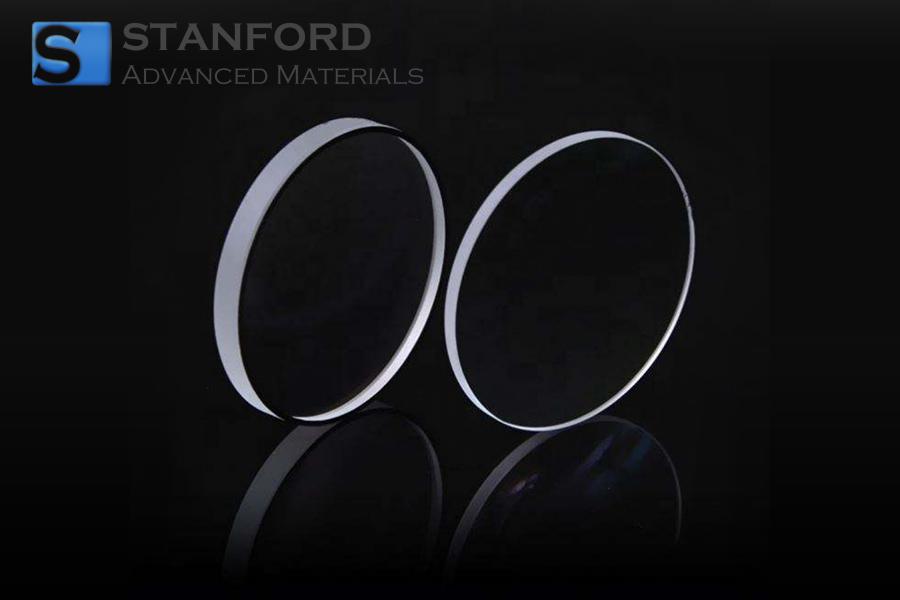
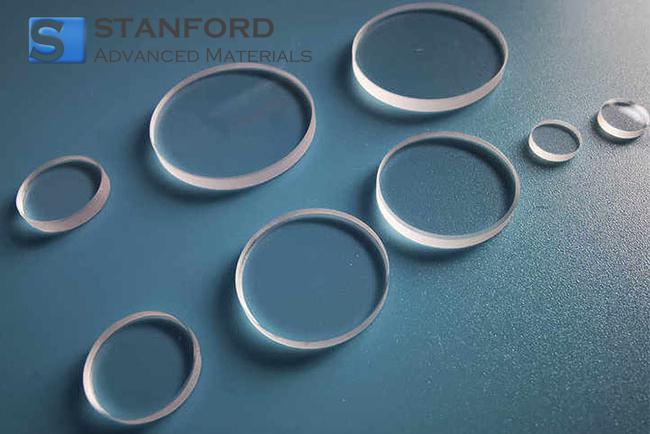
CaF₂ is widely used in polished windows, lenses, prisms, and optical blanks. With a density of 3.18 g/cm³, it exhibits very good transparency between 0.13 and 9 μm, well into both the UV and IR regions. This crystal is transparent and colourless and resistant to thermal shock and radiation damage, hence finding wide applications in high power laser systems. CaF₂ finds wide applications in ultraviolet spectroscopy, high-power laser systems, and infrared optical components where the low absorption properties minimise signal loss.

2. Magnesium Fluoride (MgF₂)
Magnesium fluoride is one of the most valued materials within optical coatings due to its extraordinary transparency in both the UV and visible spectrum; it has key uses in anti-reflection applications and in UV laser systems.
MgF₂ is available in thin films, optical coatings, and crystal form. It has a density of 3.18 g/cm³ and provides transparency from 0.12 to 7.5 μm, making it ideal for UV and visible light applications. The material is slightly yellowish in appearance and is available in single crystals or thin films. With a high purity of ≥99.99%, magnesium fluoride ensures premium optical performance for the most stringent applications related to lenses, windows, and scientific instrumentation. Its properties include moisture and radiation damage resistance, all of which make it even more suitable for high-performance optical systems.
3. Lithium Fluoride (LiF)
Lithium fluoride features a very wide transmission range, from UV to mid-IR; it is especially valued for high optical clarity and laser resistance in many applications.
Most of the lithium fluoride material is cut into windows, prisms, and plates. The material density is 2.64 g/cm³. It is transparent from 0.12 to 8.5 μm, including both UV and IR regions. The crystal is colourless and transparent, ensuring excellent clarity of the optics. LiF can be found in various applications such as spectrometers, detectors, lasers, and infrared windows. Lithium fluoride holds up well under high-energy photon exposure. Due to its high resistance to laser damage, together with stability under challenging environment conditions, lithium fluoride plays a key role in thermoluminescence dosimetry for radiation measurement devices.

4. Barium Fluoride (BaF₂)
Barium fluoride is indispensable in high-energy physics and in the field of radiation detection, wherein its resistance to extreme conditions is very important. Its wide transparency range allows for its use in both UV and IR applications.
Barium fluoride is available in crystals, optical blanks, and custom components. With a density of 4.89 g/cm³, BaF₂ offers transparency from 0.15 to 14 μm, covering a wide infrared range. It is a colourless, transparent crystal, usually provided in single crystal form with high purity (>99.99%). Barium fluoride has extensive use in optical windows and lenses for ultraviolet and infrared systems. With excellent resistance against radiation and thermal shock, it is useful for scintillators and detectors in advanced imaging systems. Applications for BaF₂ include laser fusion research and high-power laser amplifiers.

5. Strontium Fluoride (SrF₂)
Strontium fluoride is useful in high-resolution spectroscopy and laser systems where high precision and stability are required over a wide range of transparency. It also finds essential applications in the sources of VUV light.
Strontium fluoride is normally supplied as single crystals, windows, and prisms. It has a density of 4.05 g/cm³. Its transparency ranges from 0.11 to 8.5 μm, including both UV and near-IR wavelengths. It is colourless and transparent for high optical clarity. SrF₂ is utilised in optical components for lasers, spectrometers, and high-resolution spectroscopy, where it realises excellent performance. It is also utilised in precision optical components and VUV light sources owing to its good transparency in the VUV range and has thus become indispensable for advanced research.
Summary Table Key Fluoride Crystals in Optics and Lasers
|
Crystal |
Density (g/cm³) |
Transmission Range (μm) |
Transparency Range |
Applications |
|
Calcium Fluoride (CaF₂) |
3.18 |
0.13 - 9 |
UV to IR |
Lenses, prisms, windows, UV spectroscopy, high-power laser systems. |
|
Magnesium Fluoride (MgF₂) |
3.18 |
0.12 - 7.5 |
UV to visible |
Antireflection coatings, laser optics, UV lasers, scientific instrumentation. |
|
Lithium Fluoride (LiF) |
2.64 |
0.12 - 8.5 |
UV to mid-IR |
Spectrometers, laser windows, thermoluminescence dosimetry, radiation detectors. |
|
Barium Fluoride (BaF₂) |
4.89 |
0.15 - 14 |
UV to IR |
Scintillators, radiation detectors, laser fusion research, high-energy physics. |
|
Strontium Fluoride (SrF₂) |
4.05 |
0.11 - 8.5 |
UV to near-IR |
High-resolution spectroscopy, laser systems, VUV light sources, precision optical components. |
Conclusion
Crystals of fluorides, such as calcium fluoride, magnesium fluoride, lithium fluoride, barium fluoride, and strontium fluoride, are all indispensable to present-day optics and laser technologies. Having a special combination of optical transparency, radiation resistance, and thermal stability, they are important in the development of various advanced systems for both research and industrial applications. For more optical devices, please check Stanford Advanced Materials (SAM).
 Dr. Samuel R. Matthews


