

 Products
 Bars
Bars
 Beads & Spheres
 Bolts & Nuts
 Crucibles
 Discs
Discs
 Fibers & Fabrics
 Films
Films
 Flake
Flake
 Foams
Foams
 Foil
Foil
 Granules
 Honeycombs
 Ink
Ink
 Laminate
 Lumps
Lumps
 Meshes
 Metallised Film
 Plate
Plate
 Powders
 Rod
Rod
 Sheets
 Single Crystals
 Sputtering Target
 Tubes
Tubes
 Washer
 Wires
Wires
 Converters & Calculators
 Write for Us



Various Heating Elements for High Temperature Uses

Heating elements form an integral part of high-temperature equipment and are widely employed in materials processing, semiconductor device fabrication, metallurgy, research laboratories, and various high-technology industries. Contemporary high-temperature reactors employ a number of diverse heating materials, each designed to operate under specific thermal, chemical, or mechanical conditions.

Metallic Heating Elements
Tungsten Heating Elements - Effective at Extremely High Temperature Ranges
Tungsten (W) as heating elements works well at the highest possible operating temperature. Its melting point stands at 3,422°C. These heating elements are useful in vacuum furnaces, sintering machines, sapphire crystal growth machines, and high-temperature evaporation plants. They perform optimally under vacuum or an inert atmosphere. It exhibits low vapour pressure, high thermal conductivity, and stability at higher temperatures.
However, it readily oxidises at temperatures above 500°C in air. Consequently, it is normally used at low pressure and in an inert atmosphere. The heating elements have typically been manufactured as rods, wires, and mesh heaters.
Molybdenum Heating Elements - Good Performance in Vacuum and Reducing Environments
Molybdenum (Mo) is another widely used metal heater due to its good high-temperature properties and strong resilience at elevated temperatures. It melts at 2,623°C. Although not as noble as tungsten, molybdenum can be more easily machined and is relatively less expensive. Molybdenum heating elements are common in vacuum heating furnaces. Crystal pulling and vacuum metalising were initially performed using molybdenum.
Similar to tungsten, molybdenum is also an air-reactive metal that requires inert atmosphere protection. Molybdenum-La alloys and molybdenum-Zr alloys have better ductility and prolong the life of heaters.

Tantalum Heating Elements - Excellent Corrosion Resistance
Tantalum heating elements possess several desirable properties. It has an extremely high melting temperature of 3,017°C. Additionally, it presents high corrosion resistance and acts as an inert metal, primarily against acids. Furthermore, it oxidises and forms a non-protective oxide layer when exposed to air at high temperatures. It is useful for high purity processing, which includes semiconductor crystal growth.
It costs more compared to either tungsten or molybdenum and thus requires consideration only if purity or corrosion resistance issues are present.
Ceramic-based Heating Elements
Silicon Carbide (SiC) Heating Elements - Resistant to Air up to Approximately 1,600°C
Silicon carbide components rank among the most versatile ceramic heaters. These heating elements operate effectively in air without requiring either a vacuum or an inert atmosphere. Silicon carbide components possess good oxidation resistance, thermal shock resistance, and a stable service life. These components have various applications, ranging from laboratory heating furnaces and heat treatment ovens to glass processing and metal annealing.
Their electrical resistances increase with usage, and they undergo deterioration due to oxidation. Nonetheless, they remain among the most cost-effective materials for operation at mid- and high-temperatures.
Molybdenum Disilicide (MoSi₂) Resistance Heating Elements
MoSi₂ heating elements extend the maximum operating temperature beyond that of SiC heating elements as they can be operated successfully in air up to 1,800°C. They develop a safeguarding layer of silica, SiO₂, on the surface, thereby preventing any further oxidation.
MoSi₂ components are relatively more brittle compared with metal heaters but provide high thermal stability and longevity even in air.

Carbon-Based Heating Elements
Graphite Heating Elements – Conductivity and Stability At Very High Temperatures
Graphite components are capable of operating at temperatures above 2,000°C in an inert environment and reaching 3,000°C in a vacuum. The high thermal conductivity of graphite ensures efficient heating. It is widely used as an efficient heating source at very high temperatures in various metallurgy processes and epitaxy.
Graphite cannot be heated in air at high temperatures due to its reaction with oxygen. Consequently, vacuum or inert atmospheres are necessary in graphite furnace designs. Graphite heating elements are available as rods, plates, tubes, and more.
Comparison Table and How to Choose
|
Heating Element Type |
Max Operating Temperature |
Atmosphere Compatibility |
Key Advantages |
Common Applications |
|
Tungsten (W) |
~3,000°C |
Vacuum, inert |
High-temperature capability; low vapour pressure |
Sintering, crystal growth, evaporation |
|
Molybdenum (Mo) |
~1,800–2,000°C |
Vacuum, inert |
Strong at high temperatures; cost-effective |
Vacuum furnaces, brazing |
|
Tantalum (Ta) |
~2,500°C |
Vacuum, inert |
Excellent corrosion resistance; high purity |
Semiconductor processing, crystal growth |
|
Graphite |
~2,500–3,000°C |
Vacuum, inert |
High conductivity; machinable |
CVD, epitaxy, metallurgy |
|
SiC |
~1,600°C |
Air |
Oxidation resistant; durable |
Kilns, heat-treating furnaces |
|
MoSi₂ |
~1,800°C |
Air |
Self-protecting oxide layer; clean heating |
Laboratory furnaces, sintering |
All data presented above are for reference only and may vary depending on materials, processing conditions, and specific application requirements. Related reading: Heating Elements: Molybdenum Disilicide vs Silicon Carbide
- Metallic materials with high melting points, including metals such as tungsten, molybdenum, and tantalum, provide good performance under vacuum and inert atmospheres and enable high-temperature processing with extremely pure semiconductor materials.
- Silicon carbide and molybdenum disilicides are used successfully as ceramic heaters that can operate effectively with air as a medium.
- Carbon heaters, particularly graphite, provide uniformity and stability for some of the highest-temperature processes conducted in controlled atmospheres.
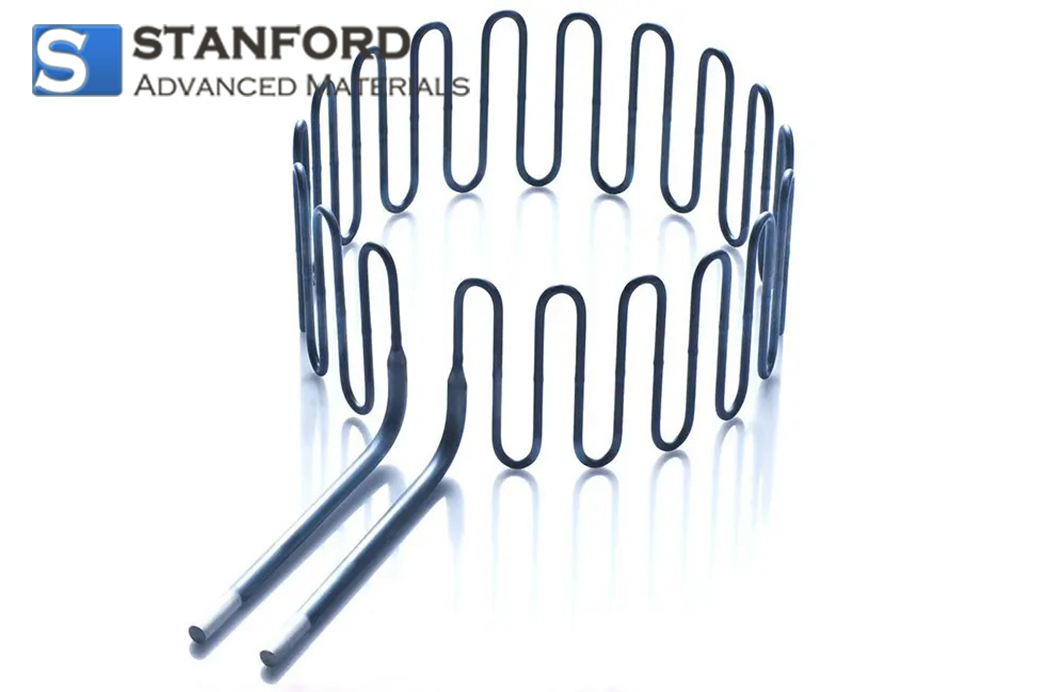
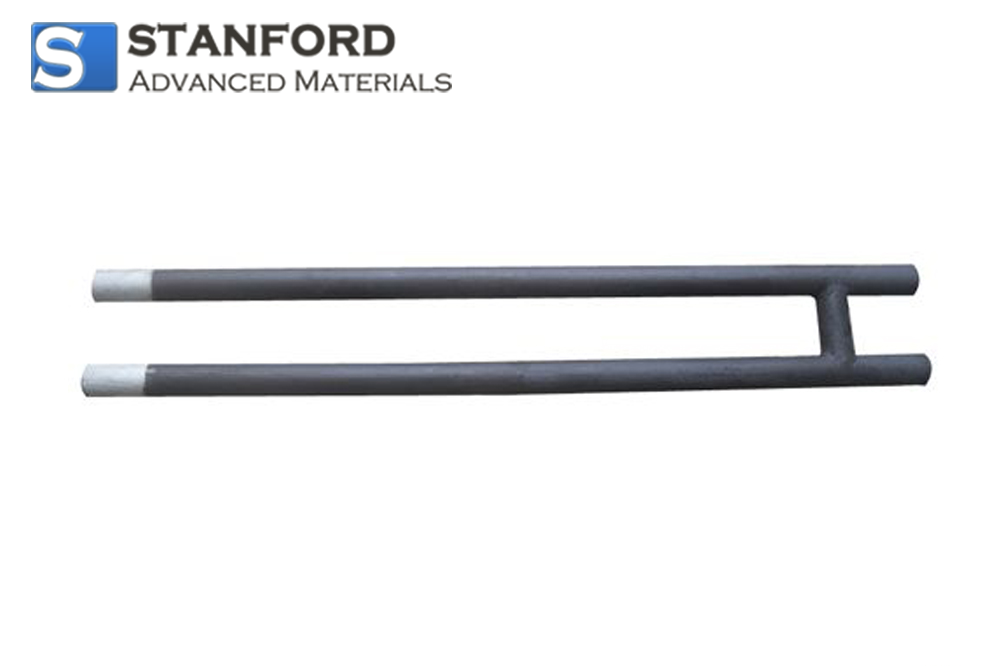
Every type of heating element, metal heating elements, ceramic heating elements, and carbon-based heating elements, has its own set of advantages suited for different heating conditions. Please visit Stanford Advanced Materials (SAM) for different types of heating elements. U-shape, W-shape, and H-shape, and customisation are available.

 Dr. Samuel R. Matthews


